The commerce layer for travel. One cart, one checkout, all suppliers.
Suppliers provide inventory. GoChatTravel provides commerce: one cart and one checkout across all your suppliers, the closest match when an offer sells out mid-purchase, and the after-sale. For banks, airlines, hotels and travel agencies, inside your own app, site or chat. Your brand, your contracts, your prices.
Read the spec now, no key. Open the demos with a Google sign-in, or the bot with no signup at all.
- No key
- Read the whole API contract before you talk to us
- 1
- Cart and one checkout across all your suppliers
- 6
- Chat channels live, plus your own app
- 4
- Live demos you can book in: bank, airline, hotel, group
See it inside a product like yours.
Four live demos on sandbox inventory. Sign in with Google and book.
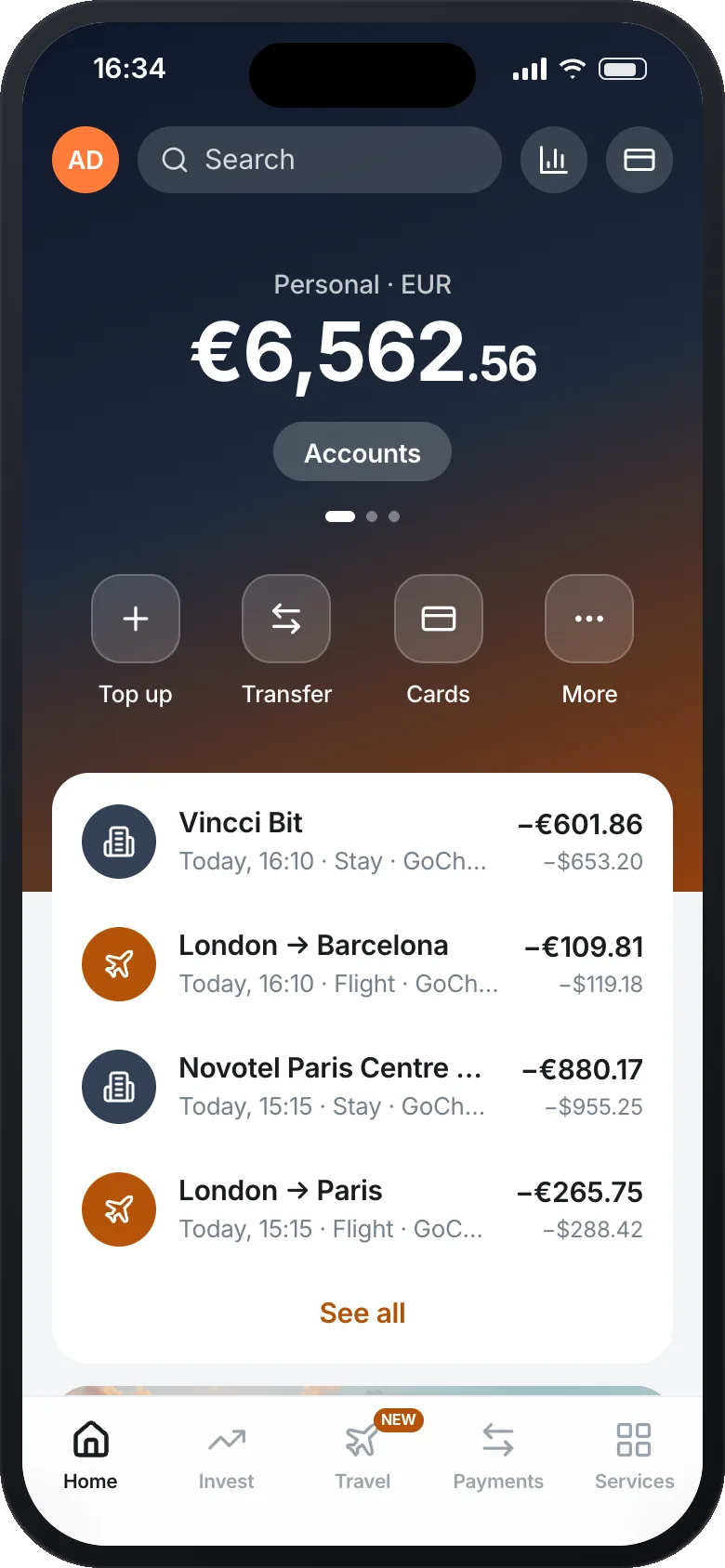
Travel inside the banking app
Paid from the bank’s own accounts and instalment plans, and the booking lands in the bank’s feed.
Open the demo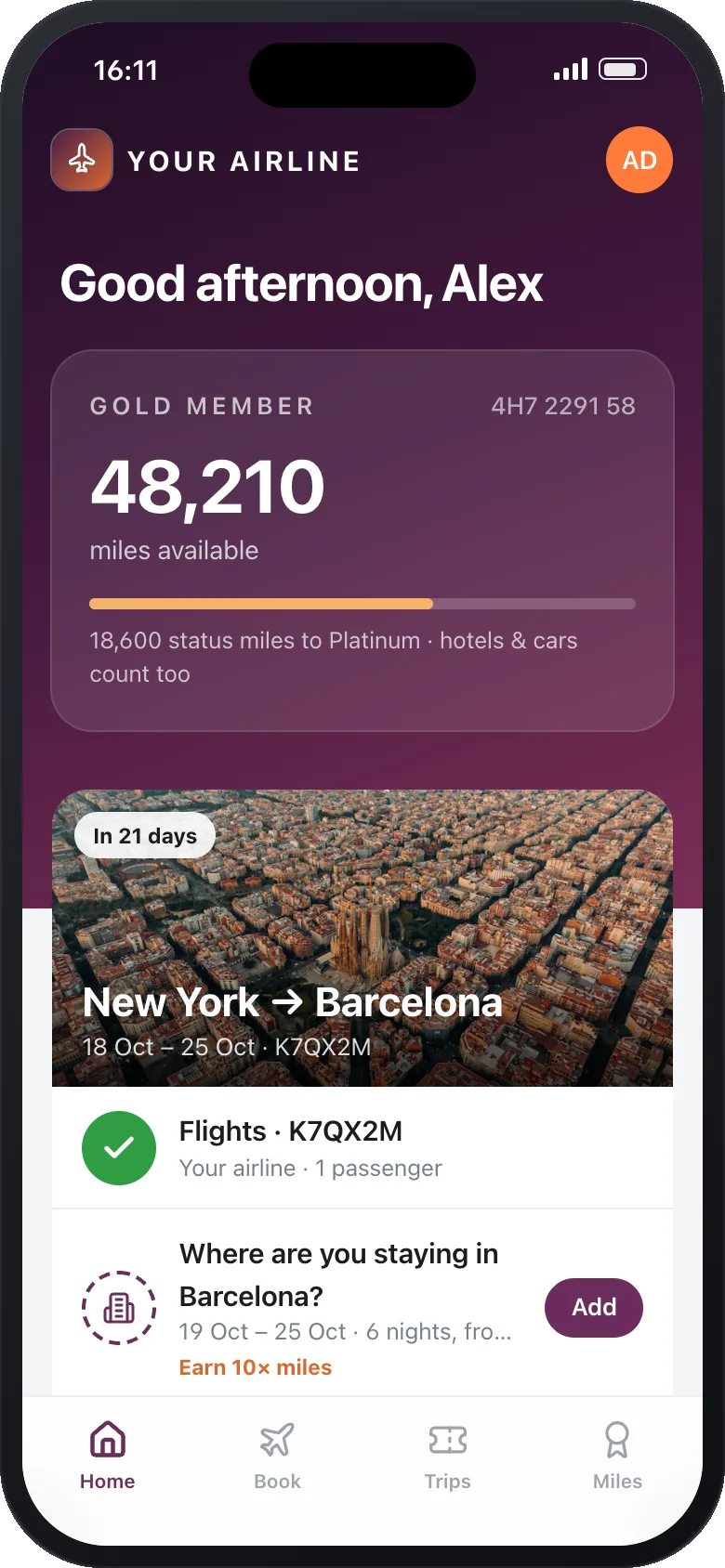
A stay and a car with every seat
The airline’s own booking record fills in the dates, the passports and the card; its loyalty programme adds the miles.
Open the demo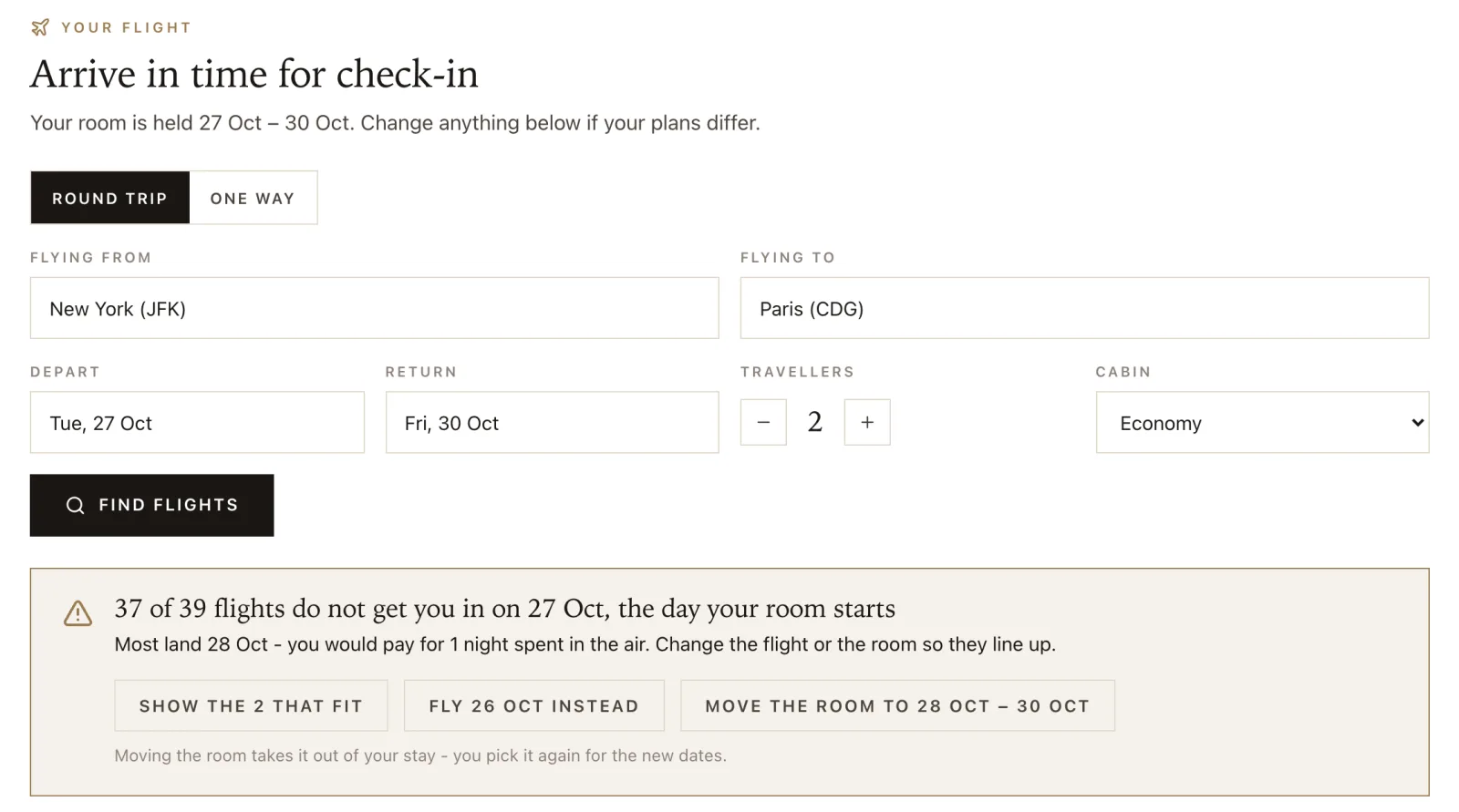
The room, the flight and the car on one booking
A hotel’s direct site that sells the journey too, and notices when the flight and the room do not line up.
Open the demo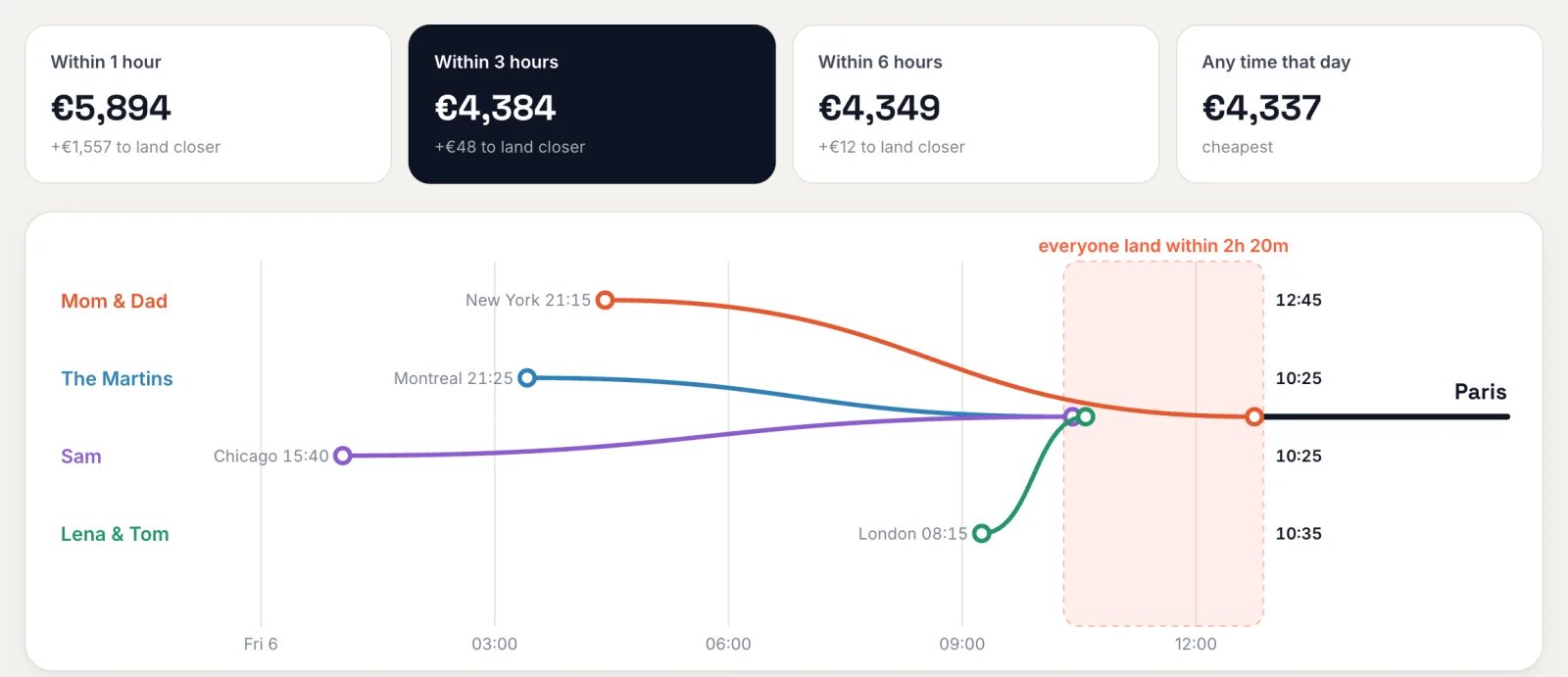
Nine people, four cities, one checkout
Every party flies from home, lands together and sleeps under one roof. The organiser sees who owes what.
Open the demoIn detail: for banks · for airlines · for hotels · for group travel · for travel agencies
Any suppliers. Any mix. One checkout.
Five hotels, four flights and six car rentals from different providers go into one basket and one checkout, the same way one of each does.
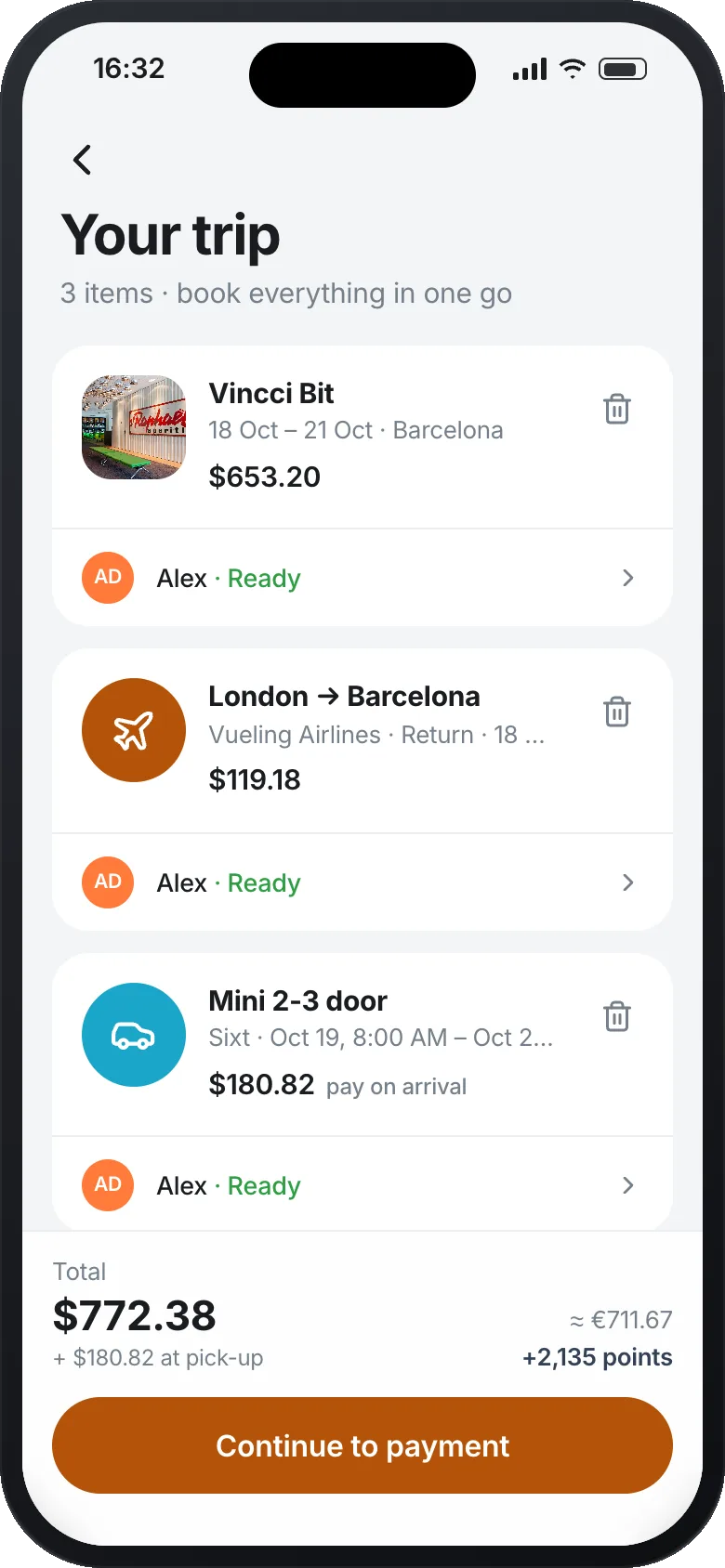
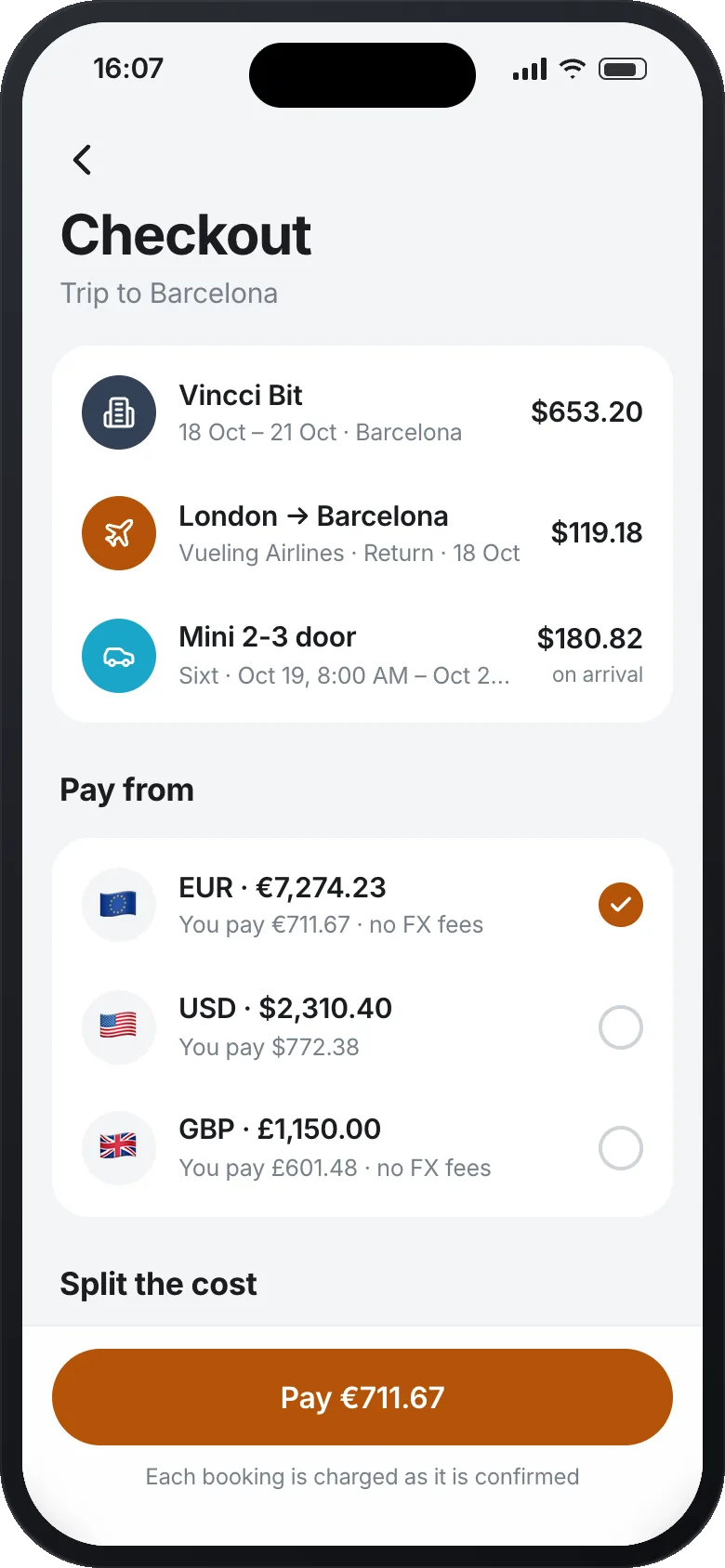
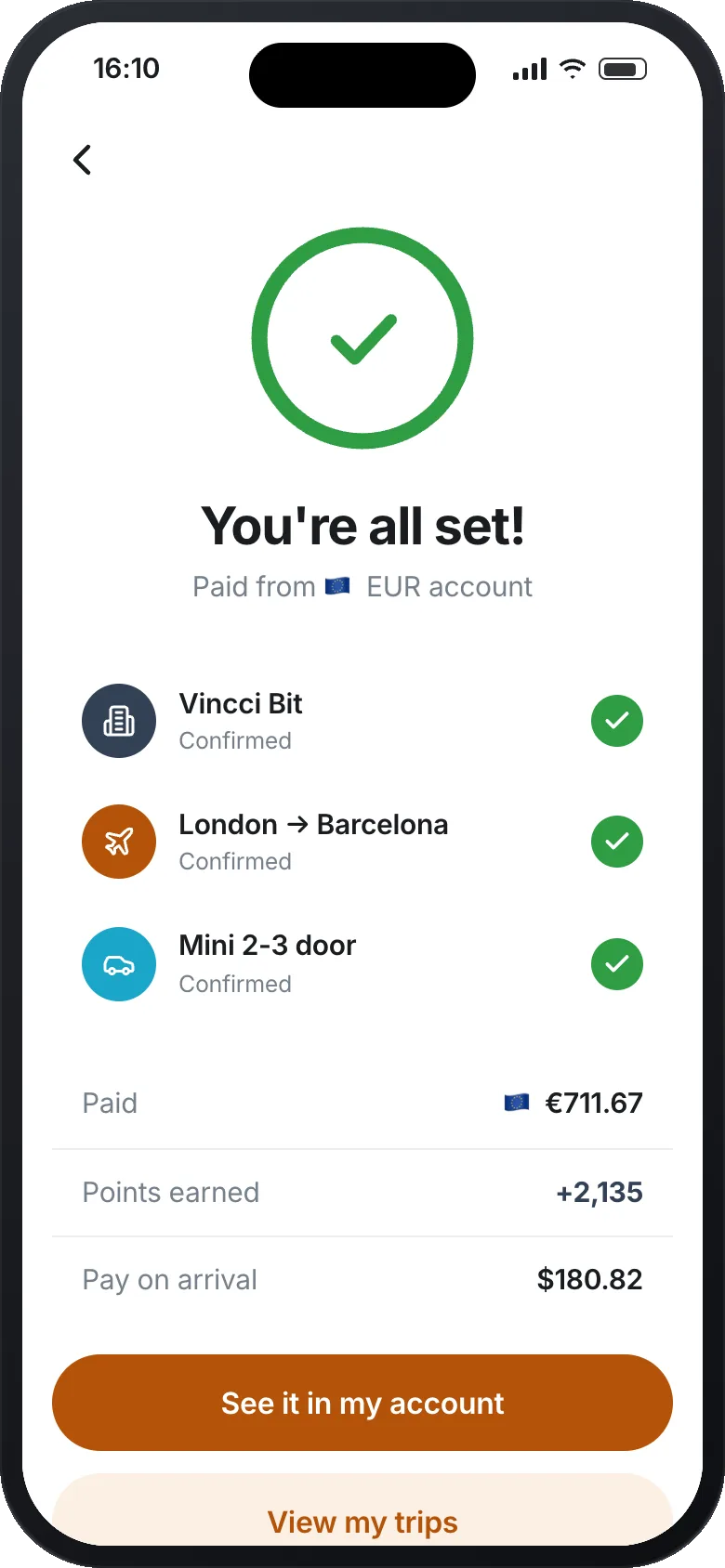
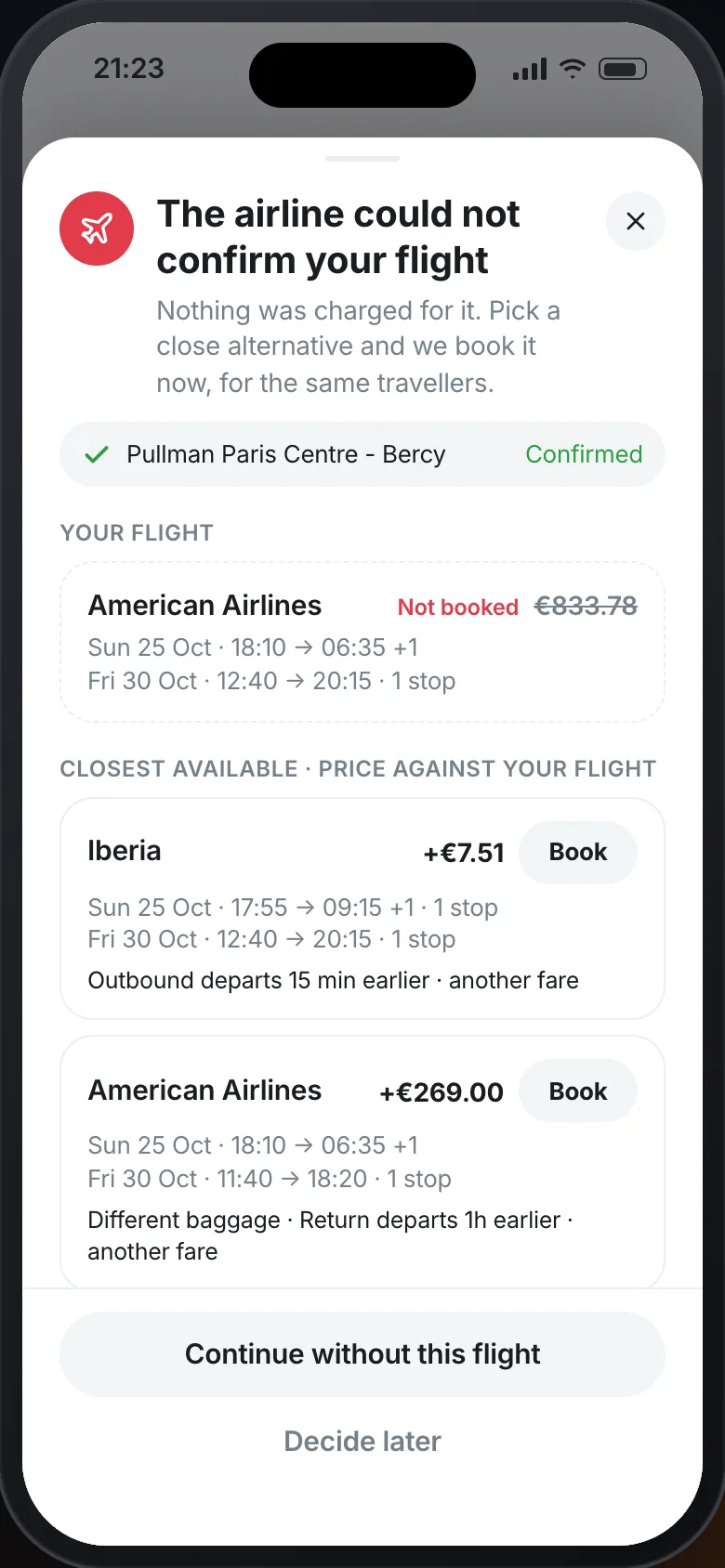
The product, not a mockup.
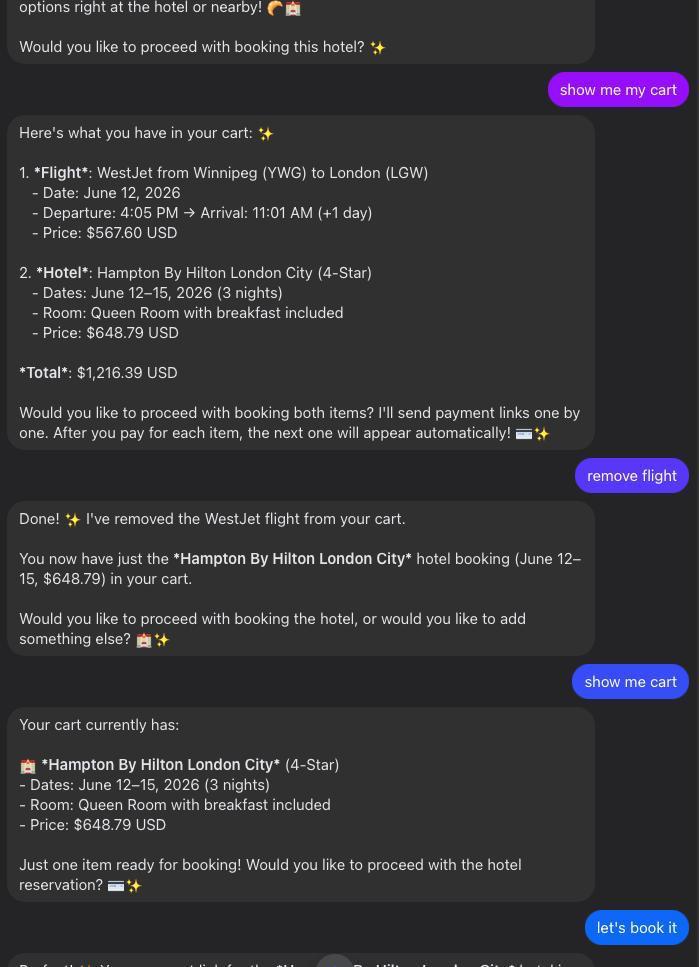
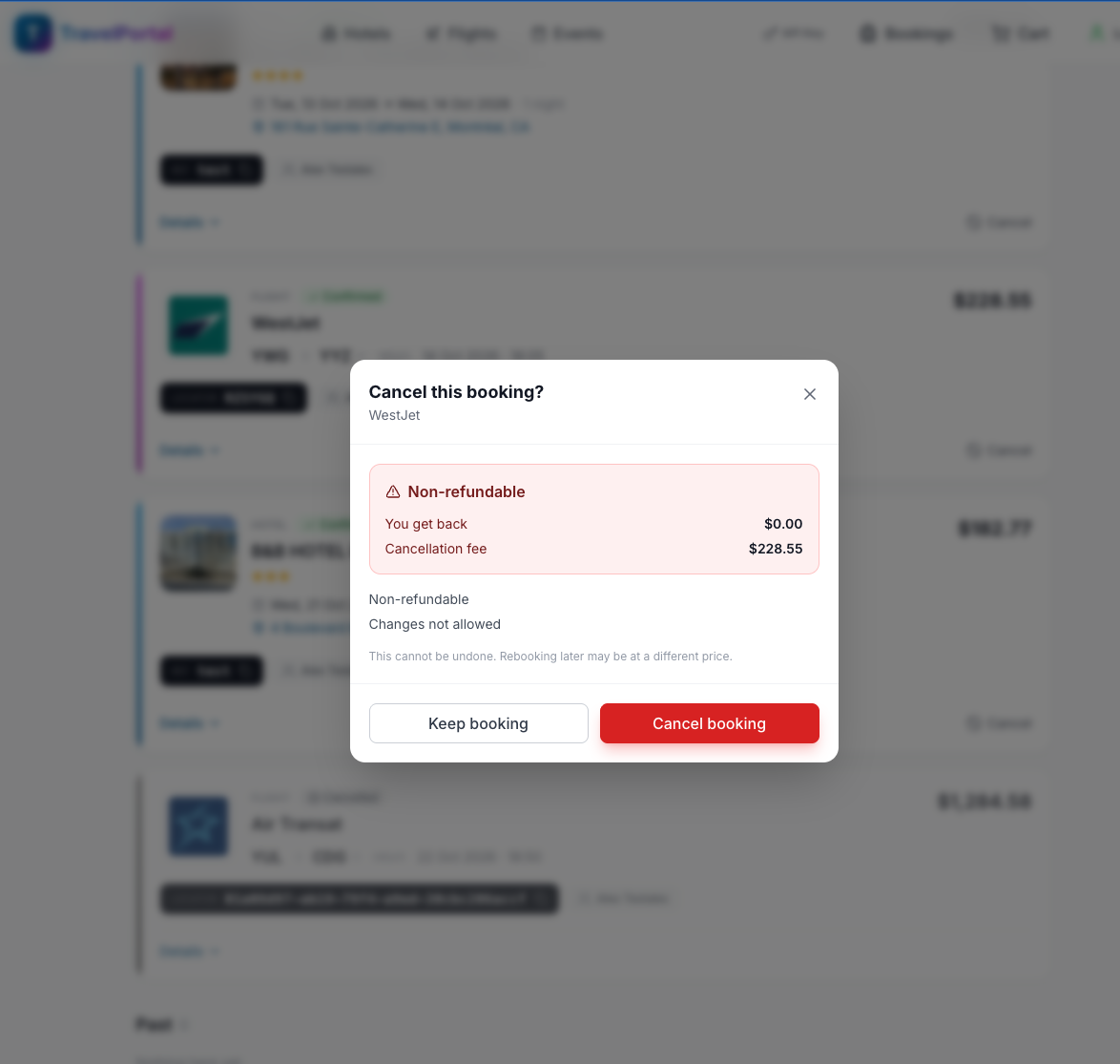
These screens are from the sandbox: real supplier inventory and live prices, on test bookings, so nothing here is a real reservation. A trip built in chat, an item removed and the total updated; a cancellation quoting the real penalty before anything is cancelled.
In production, partners run around 5,000 bookings a quarter through the same engine, and 64% of those carts hold more than one item.
Open the sandboxSign in with Google, or open it in Telegram with no signup. Test card 4111 1111 1111 1111, expiry 12/30, CVC 123.
One engine. You choose how much of it you touch.
The same engine underneath all three. What changes is how much of the interface is yours.
The API
You own the interface. We bring all your suppliers into one search, one cart and one checkout, and handle the after-sale.
- All your suppliers in one result list
- Hotels, flights, events and car rental in one cart
- Checkout, bookings and cancellation in one API
- The chat assistant, ready to embed
- Your customer stays signed in to your app
- For teams with their own front end
Reference storefront
A working storefront built on the same API. Brand it and ship it rather than build from nothing.
- Multi-item cart across suppliers
- Checkout, saved travellers and a bookings page
- Your brand, your domain
- For sellers who need a site, not a spec
Chat channels
Fully turnkey. We configure the channel, the branding and the providers; nothing for your team to build.
- WhatsApp, Telegram, Slack, Teams, Messenger, Instagram
- Live and taking real bookings
- Your suppliers and rates, or the providers we connect to
- For sellers with no engineering to spare
You are not buying inventory. You are buying a shop to sell it in.
The trip booked with you, not somewhere else
Today your customers leave your app or site to book the trip elsewhere. With the engine behind it, they book it with you, under your brand.
One cart, the whole trip
Three hotels, two flights, a car and an event, from different suppliers, in one basket and one checkout. Any number of items, and the basket is not fussy about what they are: if you sell it and it has a supplier behind it, it goes in the same cart.
Your contracts, your prices, your margin
Your credentials, your rates, your customer. The commercial relationship stays yours end to end.
As much engineering as you want, including none
Turnkey: nothing to design, nothing to integrate. Or take the API and build your own front end. Your developers are in the critical path only if you put them there.
You have already paid to acquire this customer.
The margin is rarely in the first booking. It is in the hotel beside the flight, the car, the event, the insurance. Attach rates stay low anyway, and rarely because of intent. There is no basket open, and no conversation to offer into.
A confirmation page gives you one moment. An email gives you an open rate. Neither knows the trip is eleven weeks away, and neither can ask a question.
A conversation does not close. The trip context is already in it, so an offer needs no form and no second round of acquisition spend. And because the cart is already there, the distance between yes and paid is one tap.
Every one of those is margin on a customer whose acquisition cost you have already written off. That is the whole argument.
This lands hardest when four things are already true.
-
You already have customers in your own app or site
A banking app, an airline app, a hotel site, a member portal. Travel goes in as one more screen, under your brand. Chat, if your customers already message you, runs on the same engine.
-
You have inventory, or a reason to sell ours
Your own contracts and negotiated rates, connected as they are. Or no supply of your own, and you run on the providers we already connect to.
-
Someone owns the number
Someone accountable for revenue on the travel line. Pilots that belong to no one's P&L produce a demo and nothing after it.
-
Customers who travel
Enough travellers among your customers that a travel tab pays for itself. That is where this starts showing up in the numbers.
A pilot, not a waiting list.
The banking, OTA and loyalty modules are built and running. A pilot configures what already exists against your brand and your suppliers.
What a pilot is
- One surface and one supplier set, fully branded as you
- Live and taking real bookings, not a demo environment
- Your rates, your rules, your customer
- Scoped and agreed before anything longer is signed
Why this year
- Retail settled cart and checkout two decades ago. Travel still sells one vertical at a time
- One cart, one total, one confirmation, one cancellation that needs no phone call
- That plumbing takes years to build. It is running now
- The teams buying an LLM chatbot this year are buying something that cannot take a payment
Every trip your customers book today is bought in pieces, because nothing you can hand them holds the whole thing in one cart.
Take one of the threeWhat you bring, what we do.
You bring
- A surface: your engineers, a storefront to brand, or a channel
- Your supplier credentials and negotiated rates, where you have them
- Brand: name, colours, tone, domain
- Your pricing rules and commercial terms
We do
- Issue API credentials, brand the storefront, or connect the channels — whichever you came for
- Wire in your providers and merge them into one result list, or run you on ours
- Wire up payment — Stripe in your account, your own gateway, or your existing rails
- Run it, monitor it, and handle post-sale automation
API credentials: same day. A branded storefront or a live channel is scoped work, and we put a date on it in the first conversation.
What the platform actually does
Each one is something you can put in front of a customer.
No AI guesswork in the booking
Same search, same trip, same price, every time. AI never decides what gets booked or what it costs.
One cart, all suppliers
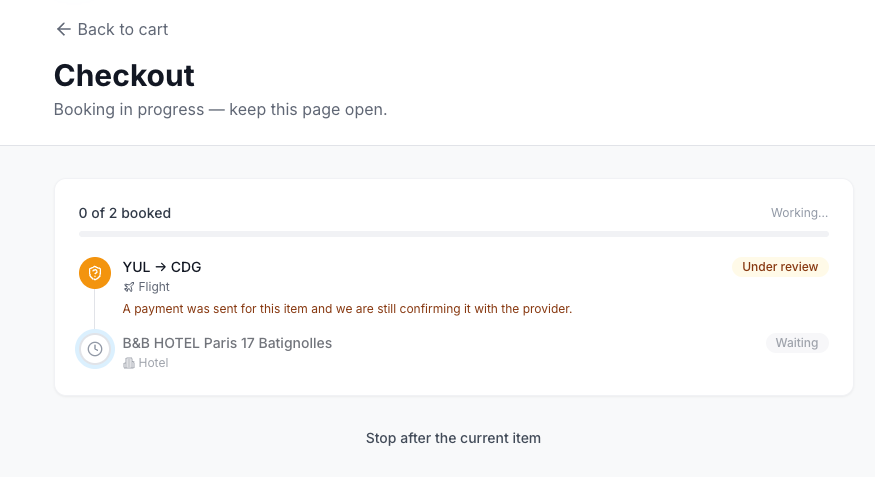
The customer builds a whole trip and reviews it as one summary. One checkout books every item with its own supplier, and the customer always sees which parts are confirmed.
Payment on your rails
Your payment provider and your rails. The customer pays the way they already pay you.
Cross-sell where the booking happens
The stay, the car and the extras offered next to the booking that needs them. No redirect, no second checkout.
Closed user group distribution
Closed user group and private rate channels are supported. The supplier decides what goes to a closed channel; we carry that decision.
Automated post-sale, or we don't ship it
A provider goes live only when cancellation and refund work without a call centre. Your customer changes or cancels where they booked — no phone number, no ticket for your support team.
Full white label
Your domain, brand, tone, pricing rules and reporting. GoChatTravel is not named anywhere the customer can see. You own the relationship and the margin.
Six live channels, plus your own app
WhatsApp, Telegram, Slack, Teams, Messenger and Instagram Direct are live, and your own app on the same engine.
Travel policy, applied before the booking
Caps, cabin and room class, advance purchase, preferred suppliers — applied while the traveller is still shopping. Out-of-policy is labelled there, not found by finance a month later.
Approvals where the work already happens
Sign-off goes to the approver in the Slack or Teams channel the company already lives in. One tap, and the trip is booked.
We are the layer, not the supply.
We are not a supplier, an aggregator or a single-vertical booking API, and we are not trying to out-supply them. We sit on top of them — Duffel, Nuitée, the GDSs, bedbanks, the aggregator you already buy from, your own direct agreements — and put one cart, one checkout and one post-sale flow on top, turnkey, in whatever interface you sell through.
-
You only need hotel supply
Go to a hotel specialist directly. More properties, cheaper, and you will not be paying for a layer you are not using.
-
You only need flights
Same answer: go direct to a flight API. One vertical, one supplier, no cart to speak of — you do not need us for that.
-
You already have a corporate travel programme
Good — keep it for duty of care, expense and mid-office. We go in front of it: the basket, the checkout, and the approval where your people already talk.
-
You want a cart and a checkout over what you already have
That is us. Several suppliers in one basket and one checkout, with policy and approvals running where your people already talk — on top of the programme or the supplier you already pay for.
We do not charge for search, because we are not the one selling you the inventory. If a supplier you brought charges for its own searches, that stays between you and them.
How this compares
Not against the suppliers themselves — we sit on top of those. Against the two things you would otherwise do: build this layer yourself on their APIs, or hand the job to an LLM-agent tool.
| Capability | GoChatTravel | Direct on supplier APIs | LLM agent tools |
|---|---|---|---|
| Deterministic booking path | Yes | Yes | No |
| Runs inside chat with no front end to build | Yes | No | Yes |
| Persistent multi-item cart across messages | Yes | You build it | No |
| Checkout included, or your own rails | Yes | You build it | No |
| Travel policy and approval flow | Per partner | You build it | No |
| Automated cancellation, or the provider is not shipped | Yes, or we drop the supplier | Provider-dependent | Rarely |
| Closed user group / private rate channel | Yes | Provider-dependent | No |
| Bring your own GDS / NDC credentials | Yes | Sometimes | No |
| Engineering effort required from you | None, or as much as you want | Substantial | Moderate |
| Per-booking token cost | None | None | Yes |
Almost none of this has to be ours.
Everything you already have stays yours. Where you have nothing, we bring it.
Your suppliers
Your contracts and your negotiated rates, and those are the rates your customers see.
- GDS, airline direct and hotel suppliers you already use
- The aggregator you already buy from
- A supplier we have not connected yet: weeks, not a quarter
- Or the providers we connect to, where you hold none
Your interface
Chat is one way to shop, a web form is another. Both sit on the same engine, so the surface is a choice rather than the product.
- Call the API from your own web or mobile app
- Brand the reference storefront and ship it
- Embed the assistant, or leave it out
- Or take a chat channel, turnkey
Your channels
The numbers and workspaces your customers already message. We set them up; you keep them.
- Your WhatsApp Business number
- Your Telegram bot
- Your Slack or Microsoft Teams workspace
- Your Messenger and Instagram pages
Your payment rails
Your customers pay the way they already pay you, and the money goes where it already goes.
Your customer’s identity
Your customer stays signed in to your app. No second login, and no account on our side.
Who this fits today
Four shapes of partner the engine already fits, and what each one plugs in.
Regional OTAs & tour operators
Add a chat channel and inventory breadth without hiring an engineering team to build distribution.
- Sell in chat alongside your existing site
- Your supplier contracts, or ours
- Cross-sell inside one conversation
- Your brand, your margins
Loyalty programmes & fintechs
Turn points, cashback or a card programme into a travel product without owning travel technology.
- Booking inside your app or chat channel
- Payment flow adapted to your rails
- Points and rewards applied at checkout
- Closed user group rates for members
TMCs & corporate travel
We are not the travel programme. We are where the trip gets bought — in front of whatever you already run, in the channel your people already use.
- Travel policy applied at search and at checkout
- Approvals in Slack or Teams, not by email
- Hotels, flights, car rental and events in one cart
- Your negotiated corporate rates
Airlines & larger enterprises
Add hotels, car rental and events to your existing channels, on your own NDC and GDS connections.
- Ancillary attach in chat channels
- NDC and GDS connections supported
- Private fare distribution via CUG
- Closed-channel member pricing
What buyers ask first.
Why not connect Sabre, Amadeus, Duffel or Nuitee directly?
Suppliers provide inventory; GoChatTravel provides commerce. Sabre and Amadeus sell flights, Duffel sells flights, Nuitee sells hotels — each through its own API, one booking at a time. None of them gives one cart across all of them, one checkout that books every item with its own supplier, the closest match booked on the spot when an offer sells out mid-purchase, travellers entered once for every item, or one after-sale flow where the customer cancels and is refunded without a call centre. That is the commerce layer GoChatTravel adds on top, under your brand, and you keep your supplier contracts.
Can I try GoChatTravel without talking to sales?
Yes, two ways, both open. The Telegram sandbox bot at t.me/go_chat_travel_sandbox_bot needs no signup and no credentials. The web sandbox at sandbox.gochattravel.com opens with a Google sign-in and holds four live demos — a bank super-app, an airline app, a hotel's direct site and a group trip — plus the reference storefront: search, cross-supplier cart, checkout, saved travellers and a bookings page. Test card 4111 1111 1111 1111, expiry 12/30, CVC 123; the demos fill it in. The OpenAPI specification at sandbox.gochattravel.com/api-docs/openapi.json is public and needs no key at all, so the contract can be read before any conversation.
What makes the cart different from other travel booking APIs?
Most travel APIs sell one vertical from one source, and leave the cart to the integrator. Here a single cart holds hotels, flights, car rentals and events from different suppliers, any number of each, and one checkout books all of them. A GDS record has always been able to hold a flight, a hotel and a car, but booking them is still one segment at a time, with no basket and no single checkout at the end.
Does GoChatTravel support corporate travel policy and approvals?
Yes. Travel policy is applied while the traveller is still shopping, so an out-of-policy option is labelled at search time rather than found in a report afterwards. A trip that needs sign-off goes to the approver in the Slack or Microsoft Teams channel the company already works in, and is booked on approval.
What exactly is deterministic about the engine, and why does it matter?
The booking itself — availability, pricing, the cart, booking and cancellation — is ordinary code: the same search gives the same trip at the same price, every time. AI is used only to talk to the customer; it never chooses what gets booked or what it costs. That is the difference procurement teams ask about.
How many supplier integrations does GoChatTravel have?
More than 15 provider APIs are integrated, across GDS, airline direct, hotel bedbanks and direct supplier connections. A supplier that is not connected yet is added in weeks, not a quarter.
Can partners use their own GDS and NDC credentials?
Yes. A partner can bring its own GDS credentials, airline direct agreements and supplier contracts, put GoChatTravel on top of an aggregator it already buys from, or run on the providers GoChatTravel is connected to. Partners keep their supplier relationships, which keeps the margin and the customer on their side.
Which chat channels are supported?
WhatsApp, Telegram, Slack, Microsoft Teams, Facebook Messenger and Instagram Direct are live. Other messengers, and an embedded chat inside a partner's own application, are added on request. The Telegram sandbox is open to anyone without signup; access to the other channels is arranged on request.
Commercial terms are set per partner.
A loyalty programme with its own hotel contracts and an OTA on our suppliers are not the same deal. Tell us which you are and we put numbers on it in the first conversation.